What is matcha, exactly?
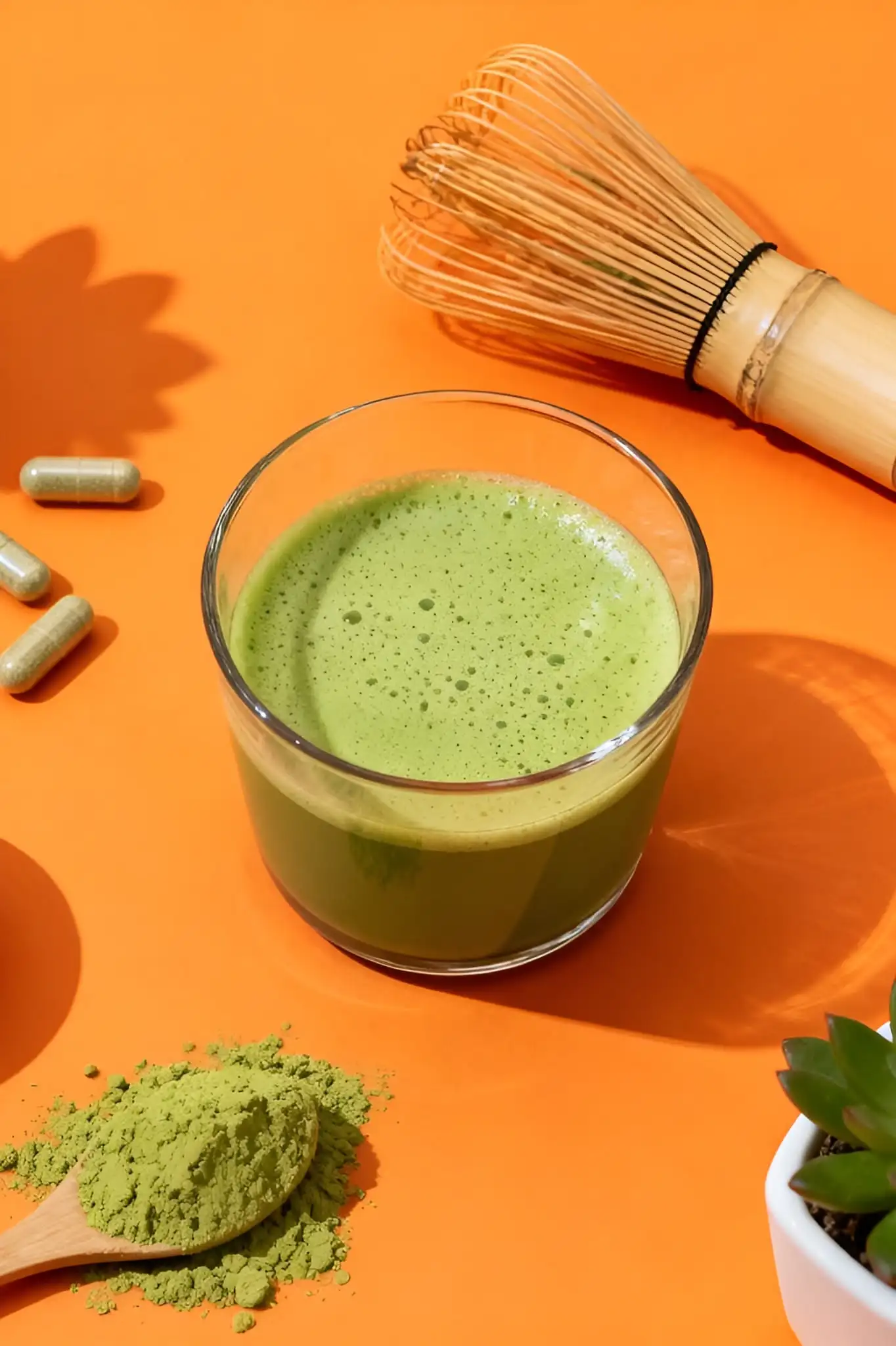
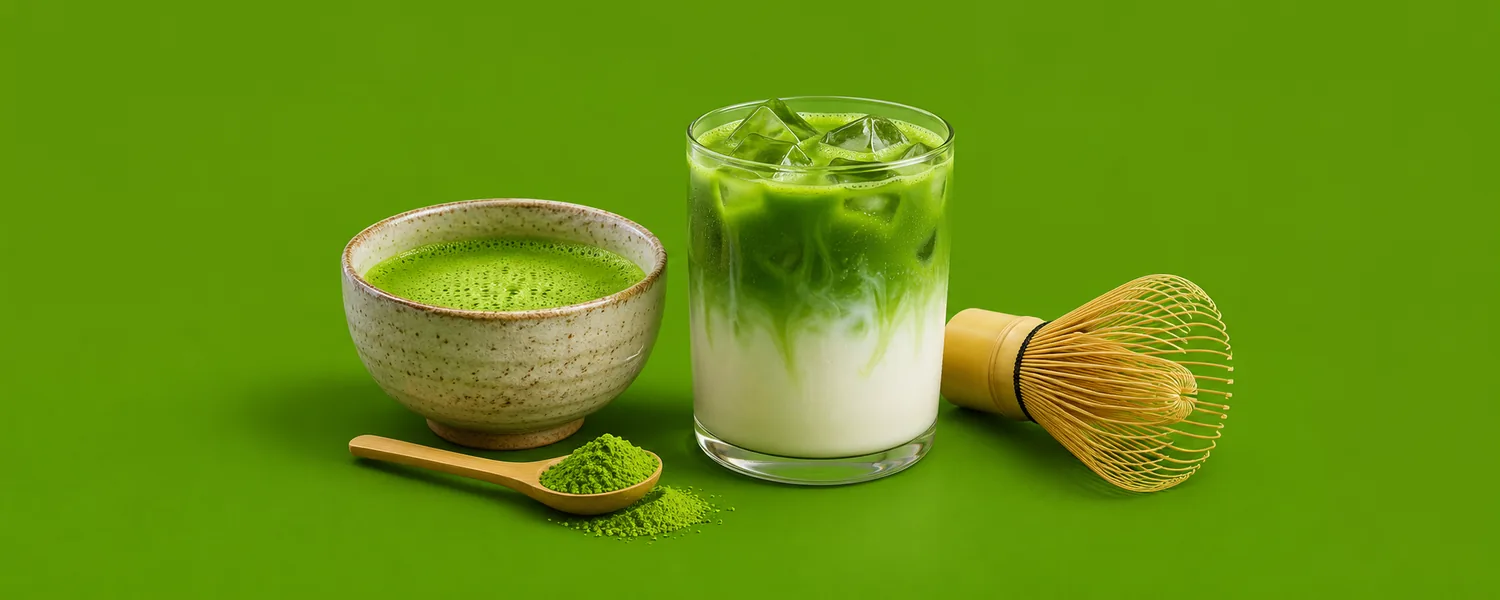
Matcha is green tea from shaded plants, steamed, dried and stone ground into a very fine powder. Unlike a tea bag, the leaf is not thrown away: you whisk it into water and drink all of it. That single fact explains most of what follows, from the taste to the caffeine.
For several weeks before harvest, the bushes grown for matcha are covered to block most of the sunlight. A 2020 review of matcha's chemistry explains that shading keeps more theanine, an amino acid behind the sweet, savoury taste, and more chlorophyll, which gives the vivid green colour. The leaves are then steamed, dried and destemmed; this leaf, called tencha, becomes matcha once ground.
Matcha is a tea, a food, neither a supplement nor a medicine; latte mixes and capsules sold under the same name are different products. This guide covers the plain powder you drink; to buy one, see our best matcha ranking of four matchas that ship to the Gulf.
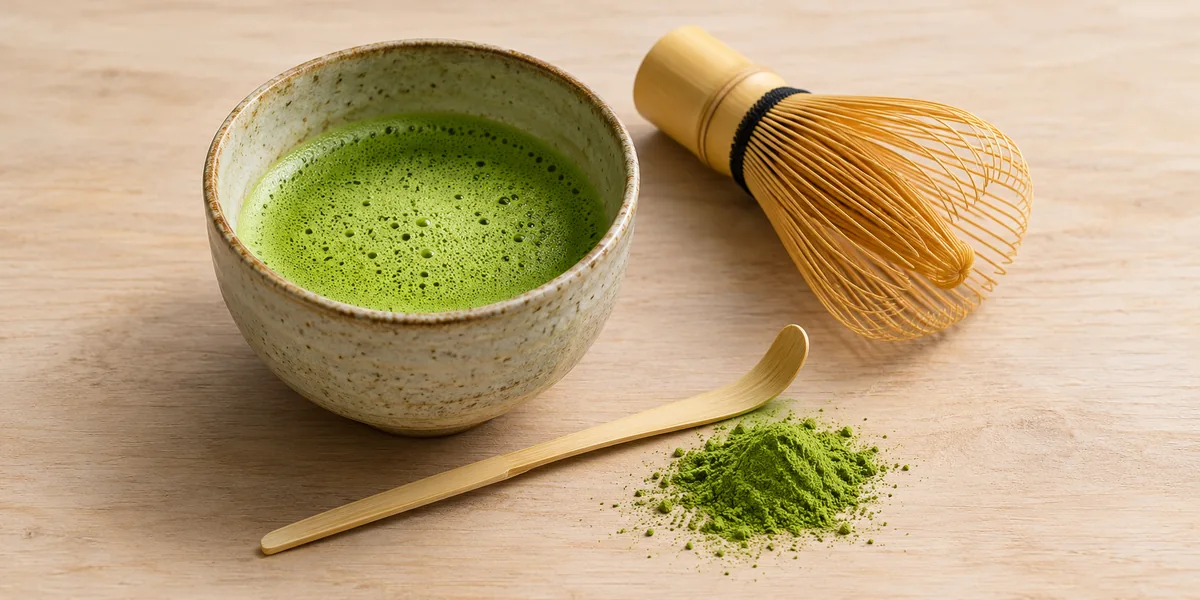
What a cup of matcha actually contains
Most lists of matcha benefits start from three compounds found in all green tea: caffeine, L-theanine and catechins, mainly EGCG (epigallocatechin gallate). The difference is the quantity you swallow with the whole leaf, which varies a lot between tins.
What has been measured in matcha (sources at the bottom of the page)
| Compound | Measured in matcha | For a 2 g cup (our calculation) |
|---|---|---|
| Caffeine | 18.9 to 44.4 mg per gram in the samples analysed by Koláčková and colleagues, as reported in a 2020 review | About 38 to 89 mg |
| L-theanine | From about 2.5 to 44.7 mg per gram in the samples tested by Unno and colleagues (2018) | About 5 to 89 mg |
| EGCG | 280 mg in the 4 g serving used in a 2017 study, with 136 mg of caffeine and 67 mg of theanine | About 140 mg for that matcha |
Matcha caffeine: how much per cup?
Somewhere between a cup of black tea and a filter coffee. With 2 g of powder, the published range gives roughly 38 to 89 mg; a latte with 3 g or a thick koicha with 4 g can go well beyond. Brands rarely print a figure: Yuno, one of the brands in our ranking, states 30 to 35 mg per gram for its barista matcha.
L-theanine and the "calm energy" story
Shading preserves L-theanine, which is why good matcha tastes rounder and less bitter. But the amount varies: when Unno's team analysed matchas on sale, 50 of 76 samples bought in Japan contained more than 17 mg of theanine per gram, against only 6 of 67 samples sold abroad.
Catechins, EGCG and the "137 times" myth
The claim that matcha has "137 times more antioxidants" than green tea comes from a 2003 laboratory study comparing the EGCG available from matcha with one brand of steeped green tea; against the highest values published for other green teas, matcha was at least three times higher. A test-tube comparison of two products, not a measure of what happens in your body.
Matcha benefits: what the studies actually show
Search for matcha benefits and you will find promises about focus, calm, metabolism and skin. Studies on matcha itself, as a drink, are far rarer than studies on green tea extracts or isolated L-theanine and caffeine. Here are the main ones we read.
Human studies on matcha and its compounds
| Study | Who and how long | What was measured | Result as published |
|---|---|---|---|
| Dietz and colleagues, 2017 | 23 adults, single servings of 4 g of matcha as a drink or a bar | Attention and memory tests one hour later, and mood | Small improvements on basic attention and speed tasks, little effect on other tasks, no change in mood |
| Unno and colleagues, 2018 | 39 pharmacy students, 3 g a day for 15 days | Anxiety score during a work placement | Lower anxiety with a matcha chosen for its low caffeine and EGCG ratio than with a "placebo" matcha richer in caffeine |
| Sakurai and colleagues, 2020 | 61 older adults in Japan, 3 g a day for 12 weeks | Cognitive test scores | Improvement on one score in women only, in a sex-specific analysis |
| Huang and colleagues, 2026 (review) | 4 randomised trials of repeated matcha intake | Cognitive function in adults | Most trials found no significant change in global cognitive function; evidence limited and inconclusive |
| Payne and colleagues, 2025 (review) | 50 randomised trials of tea, L-theanine, or L-theanine with caffeine | Cognition, mood and sleep | Small to moderate differences on some tasks in the first two hours, with wide uncertainty |
The limits matter. The three matcha trials each involved a few dozen people, lasted one hour to twelve weeks, and measured test scores, not long-term health. Two used a matcha selected for its composition, the Sakurai study was supported by a matcha research group as well as a public grant, and most L-theanine research used capsules rather than tea. For body weight, the US National Center for Complementary and Integrative Health (NCCIH) describes at most a modest effect of green tea catechins and caffeine, mostly with extracts: matcha is not a slimming product.
What a label may say. In Saudi Arabia and the UAE, as in Europe, a food may not claim to treat, cure or prevent a disease, and health claims are tightly regulated. A tin promising fat burning, "cleansing" or "x times more antioxidants" goes beyond the evidence and the rules. Fairly described, matcha benefits come down to a distinctive taste, moderate caffeine and compounds still being studied.
Matcha risks and side effects: who should be careful
An honest page on matcha benefits also needs its risks. NCCIH notes that no safety concerns have been reported for green tea consumed as a beverage by adults, while reminding that it contains caffeine. Caution is needed on the points below.
Caffeine: the EFSA limits
The European Food Safety Authority (EFSA) concluded in 2015 that up to 400 mg of caffeine a day, spread over the day, raises no safety concerns for healthy adults, nor do single doses up to 200 mg. Two strong cups of matcha (up to about 180 mg), two filter coffees (about 90 mg each, EFSA figures) and one energy drink (about 80 mg) already make around 440 mg. Count Arabic coffee and karak tea too.
- Pregnancy and breastfeeding: EFSA sets 200 mg a day from all sources, which can mean one cup of matcha and nothing else caffeinated. Ask your doctor.
- Children and teenagers: EFSA proposes 3 mg per kg of body weight per day, about 90 mg for a child of 30 kg (our calculation). Matcha lattes are not a children's drink.
- Sleep: according to EFSA, 100 mg of caffeine close to bedtime may affect sleep in some adults. Keep matcha for the morning or early afternoon.
- Anxiety, heart rhythm problems or high blood pressure: start with 1 g and ask your doctor.

Empty stomach, iron, medicines and extracts
Matcha on an empty stomach
For concentrated green tea extracts, European law requires the warning "should not be consumed on an empty stomach", because fasting increases the amount of EGCG reaching the blood. The rule does not cover tea drinks, but having strong matcha with or after food is a sensible habit.
Iron absorption
In a classic 1999 study, black tea served with a bread meal cut iron absorption by 79 to 94%, and every polyphenol-rich drink tested reduced it. Green tea was not tested, but it is also rich in polyphenols: with low iron or in pregnancy, drink matcha between meals.
Medicines
- Nadolol (a beta blocker): in 10 healthy volunteers who drank 700 ml of green tea a day for 14 days, blood levels of nadolol fell by about 85%.
- Atorvastatin and raloxifene: NCCIH reports that green tea extract can lower blood levels of atorvastatin, and that an interaction between green tea and raloxifene has been shown.
- Anticoagulants such as warfarin: matcha contains vitamin K, as the Sakurai study points out. If your treatment depends on a steady vitamin K intake, tell your doctor.
If you take any regular medication, ask your doctor or pharmacist before making matcha a daily habit.
Green tea extracts and the liver: not the same as the drink
In 2018 EFSA concluded that catechins from green tea infusions and similar drinks are generally safe, but that 800 mg of EGCG a day or more from food supplements was associated with signs of liver damage, and it could not set a safe dose for supplements. Since 2022, European law limits green tea extracts to less than 800 mg of EGCG per daily portion, with warnings for pregnant and breastfeeding women and under-18s, and NCCIH notes that the rare liver cases mainly involved tablets or capsules. A cup of matcha is not a capsule, but since you swallow the whole leaf, stay moderate and do not add green tea supplements.
Lead and leaf quality
A study in China linked lead in tea leaves to industrial activity, road traffic and some processing steps. With matcha you swallow the leaf itself, so its quality matters more. One analysis concluded that a daily 5 g serving of the matchas tested did not contribute to tolerable intakes for aluminium, tin, cadmium and mercury: reassuring for those samples, but no guarantee for every product, and lead was not covered. Be wary of cheap powders with no country of origin.
Matcha vs coffee (and Arabic coffee)
Matcha vs coffee is less about which is "healthier" than about dose, timing and what you add. EFSA's approximate values help to place matcha:
| Drink | Usual serving | Approximate caffeine |
|---|---|---|
| Matcha, 2 g of powder | 70 to 250 ml | About 38 to 89 mg (our calculation) |
| Espresso | 60 ml | 80 mg |
| Filter coffee | 200 ml | 90 mg |
| Black tea | 220 ml | 50 mg |
| Energy drink | 250 ml can | 80 mg |
Arabic coffee (qahwa) is not on EFSA's list: small cups, but often several in a row, so the total adds up. Switching to matcha does not automatically mean less caffeine; you mainly change the taste and the ritual.
How to make matcha: the classic method
The everyday style is usucha, or thin tea. You need a bowl, a small sieve and ideally a bamboo whisk (chasen).
- Sift 2 g of matcha, about one level teaspoon, into a warmed bowl to break up lumps.
- Add about 70 ml of water at 75 to 80 °C. Without a thermometer, let boiled water rest a few minutes: boiling water brings out bitterness.
- Whisk briskly in a zigzag (an M or W shape) for 15 to 20 seconds, until a fine foam covers the surface.
- Drink straight away, before the powder settles.
No whisk? A milk frother or a closed jar shaken hard works. Koicha, the thick ceremonial tea, uses about twice the powder, so twice the caffeine.
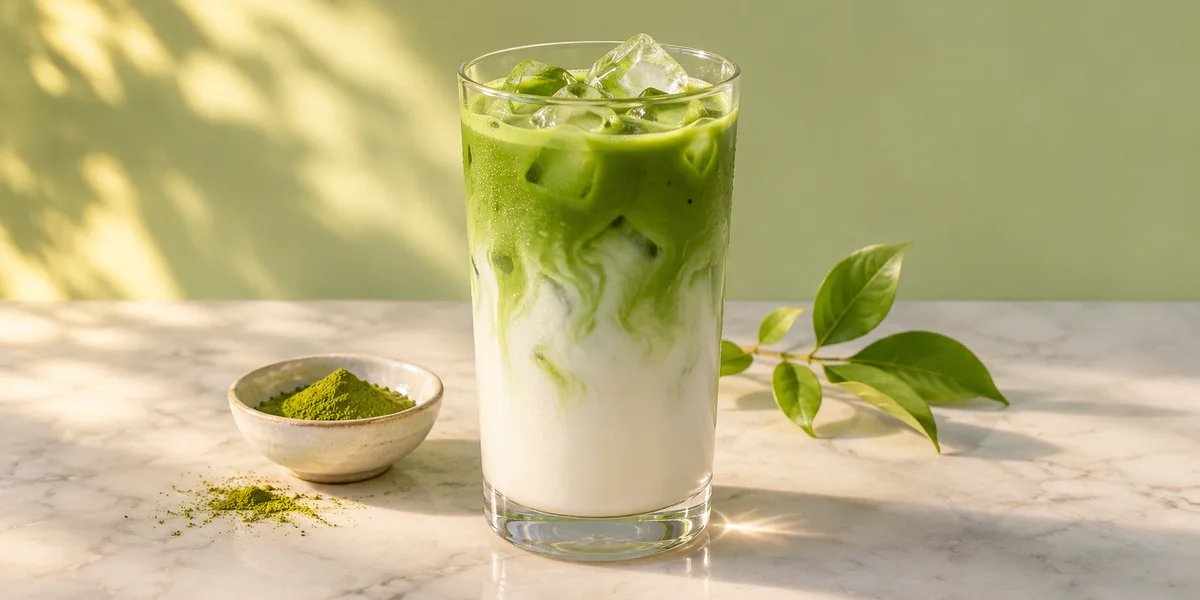
Matcha latte recipe, hot or iced
A latte is how most people in the Gulf discover matcha. This matcha latte recipe makes one 250 ml glass:
- Whisk 2 g of matcha (up to 3 g for a stronger taste) with 40 to 50 ml of water at about 80 °C until smooth.
- Heat 180 to 200 ml of milk without boiling, and froth it if you like.
- Pour the milk onto the matcha and taste before adding any sweetener.
Iced matcha latte for Gulf summers
For an iced matcha latte, shake 2 g of matcha with 50 ml of cold water in a closed jar for 20 seconds, fill a glass with ice and 180 ml of cold milk, and pour the green shot on top. Stir before drinking. Oat milk foams well, and a pinch of cardamom suits the grassy notes. Watch the sugar: ready-made "matcha latte" powders are often mostly sugar and milk powder.
Ceremonial or culinary grade, and storage in the heat
"Ceremonial" and "culinary" have no legal definition. Ceremonial usually means first-harvest, long-shaded leaves for drinking plain; culinary grades come from later harvests, taste stronger, cost less and suit lattes and baking. A bright jade green is a good sign, a dull yellowish powder suggests old stock.
Heat, light, air and humidity spoil matcha. Never leave a parcel in a hot car, keep the tin tightly closed in a cool dark place or, once opened, in the fridge (let it warm up before opening), and finish it within one to two months.
How to choose matcha in Dubai, the UAE and Saudi Arabia
- One ingredient: 100% green tea, no sugar, milk powder or flavouring.
- A named origin: country, ideally region (Uji, Nishio, Yame, Shizuoka, Kagoshima), cultivar and harvest.
- A date and a tin or pouch that blocks light.
- A sensible price per cup: price divided by weight, multiplied by 2 g.
- No health promises: the real matcha benefits are taste and quality, so a serious brand describes its tea, not what it will do to your body.
Whether you are looking for matcha in Dubai, Abu Dhabi or Riyadh, the four partner brands in our best matcha 2026 ranking sell through their own stores and deliver to the Gulf. Prices read on 18 November 2026, code applied:
- Yuno Matcha Ceremonial Grand Cru (8.9/10): organic, Okumidori from Yame, first harvest. 30 g, AED 129.60 or SAR 133.20 with LMC10.
- Matcha Botanicals Single Origin (8.6/10): a single field near Kyoto, Okumidori. 40 g, AED 157.25 or SAR 160.65 with LMC.
- Amoseeds Organic Ceremonial (8.4/10): organic, cultivar not named, lowest price per cup. 100 g, about AED 110.53 or SAR 112.72 with LMC10.
- Japanese Green Tea Co (8.2/10): Arahataen farm in Shizuoka, Yabukita. 50 g, AED 131.40 or SAR 134.10 with LMC.
Shipping, customs and VAT (5% in the UAE, 15% in Saudi Arabia) can be added on delivery. All our matcha pages are in the matcha category.
FAQ
Is it safe to drink matcha every day?
For healthy adults, one or two cups a day stay within the EFSA limit of 400 mg of caffeine a day from all sources. Count your other caffeinated drinks, and ask your doctor first if you are pregnant, take medication or have low iron.
Does matcha have more caffeine than coffee?
Not necessarily. Based on published ranges, 2 g of matcha gives about 38 to 89 mg of caffeine, against about 80 mg for an espresso and 90 mg for a filter coffee according to EFSA. A latte made with 3 or 4 g of powder can match or exceed a coffee.
What are the real matcha benefits?
What is established is simple: matcha is a tea with a distinctive taste, a moderate dose of caffeine, and L-theanine and catechins that researchers study. Small trials measured short-term effects on test scores, but recent reviews judge the evidence limited.
Is matcha a slimming drink?
Matcha is not a slimming product. NCCIH describes at most a modest effect on body weight for green tea catechins and caffeine, varying with the product and mostly seen with extracts. Green tea fat burner capsules are a different product, with the liver concerns described above.
How much matcha powder per cup?
Usually 2 g, about one level teaspoon, for a thin usucha, 2 to 3 g for a latte, and around 4 g for a thick koicha. If you are sensitive to caffeine, start with 1 g.
Can I drink matcha during Ramadan?
Yes, between iftar and suhoor. A cup late at night can shorten sleep, so many people prefer it soon after iftar. Drink enough water alongside it.
Sources
- Kochman et al., health benefits and chemical composition of matcha green tea: a review, Molecules 2020
- Koláčková et al., matcha tea: nutritional composition, phenolics and antioxidant activity, Plant Foods Hum Nutr 2020
- Unno et al., stress-reducing function of matcha green tea in animal experiments and clinical trials, Nutrients 2018
- Weiss and Anderton, determination of catechins in matcha green tea, J Chromatogr A 2003
- Dietz et al., matcha tea in drink and snack bar formats, mood and cognitive performance, Food Res Int 2017
- Sakurai et al., matcha green tea powder and cognitive functions of older adults, Nutrients 2020
- Huang et al., matcha tea and cognitive function: systematic review and meta-analysis, J Epidemiol 2026
- Payne et al., tea, L-theanine and L-theanine plus caffeine on cognition, sleep and mood: meta-analysis, Nutr Rev 2025
- European Food Safety Authority, scientific opinion on the safety of caffeine, 2015
- European Food Safety Authority, caffeine: safe intakes and caffeine in common drinks
- European Food Safety Authority, EFSA assesses safety of green tea catechins, 18 April 2018
- European Food Safety Authority, scientific opinion on the safety of green tea catechins, 2018
- Commission Regulation (EU) 2022/2340 on green tea extracts containing EGCG
- US National Center for Complementary and Integrative Health (NIH), green tea, updated February 2025
- Hurrell et al., inhibition of non-haem iron absorption by polyphenol-containing beverages, Br J Nutr 1999
- Misaka et al., green tea ingestion greatly reduces plasma concentrations of nadolol, Clin Pharmacol Ther 2014
- Jin et al., lead contamination in tea leaves and non-edaphic factors, Chemosphere 2005
- Koláčková et al., amino acids, minerals and trace elements in matcha: a nutritional evaluation, J Food Compos Anal 2021
Matcha is a food, not a medicine. It does not treat or prevent any disease and is no substitute for a varied, balanced diet and a healthy lifestyle.

Best Supplement Arabia content is written by our editorial team from the information published by the brands. Scores out of 10 rely on a public grid of 5 criteria*, completed by the editorial team’s judgement.
To support Best Supplement Arabia, links on the site are affiliate links: we may earn a commission when you buy through them, at no extra cost to you. Using the site means you accept our terms of use and our editorial policy.