What is shilajit?
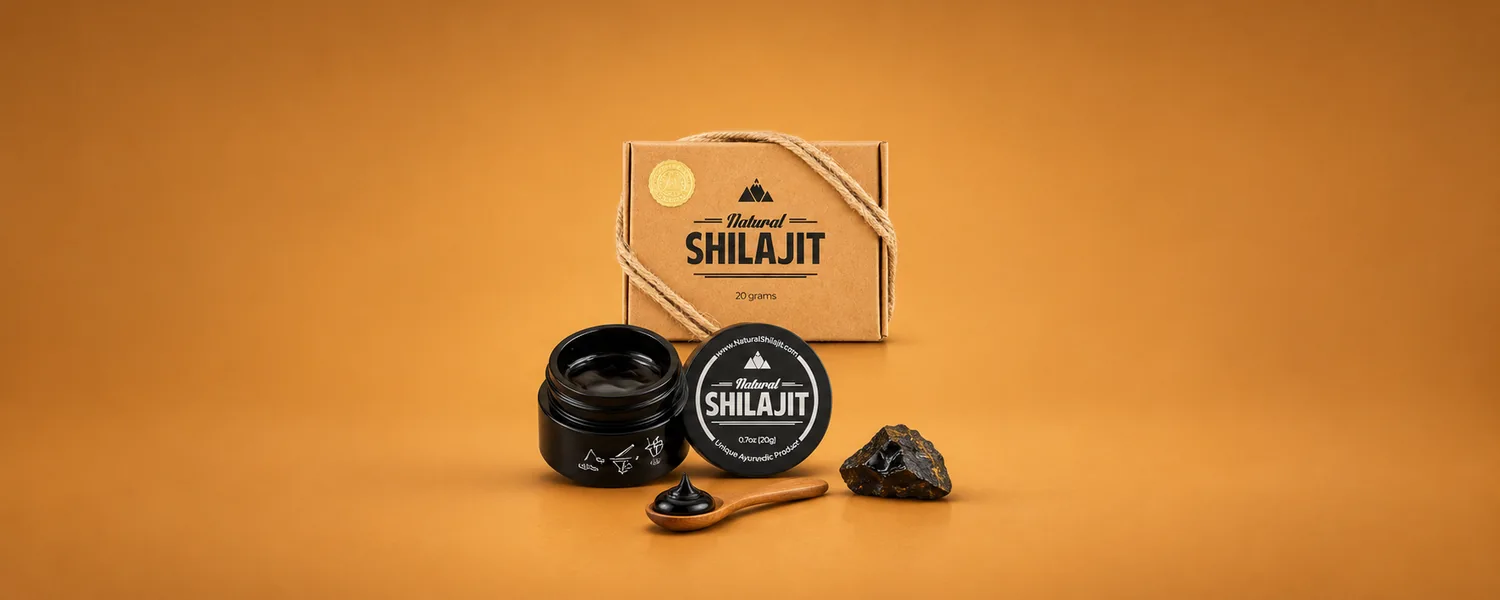
Shilajit is a sticky, brown to black substance that seeps from rock crevices in high mountains, mainly the Himalayas, formed from plant matter that broke down slowly over centuries. It is mostly humic material, chiefly fulvic acid, plus minerals such as calcium, potassium and magnesium.
It is also called mumie in Central Asia and has a long history in Ayurveda, India's traditional medicine. A 2023 review of the available analyses found that more than 80% of its mass is humic substances and around 20% is calcium, potassium and magnesium, alongside amino acids, plant compounds and heavy metals. The same review says its full composition is not known with certainty and varies a lot by region.
That variability is the whole story. Unlike magnesium or vitamin D, shilajit has no fixed specification, so judging a product comes down to how the maker purified and tested it. That is the basis of our best shilajit comparison.
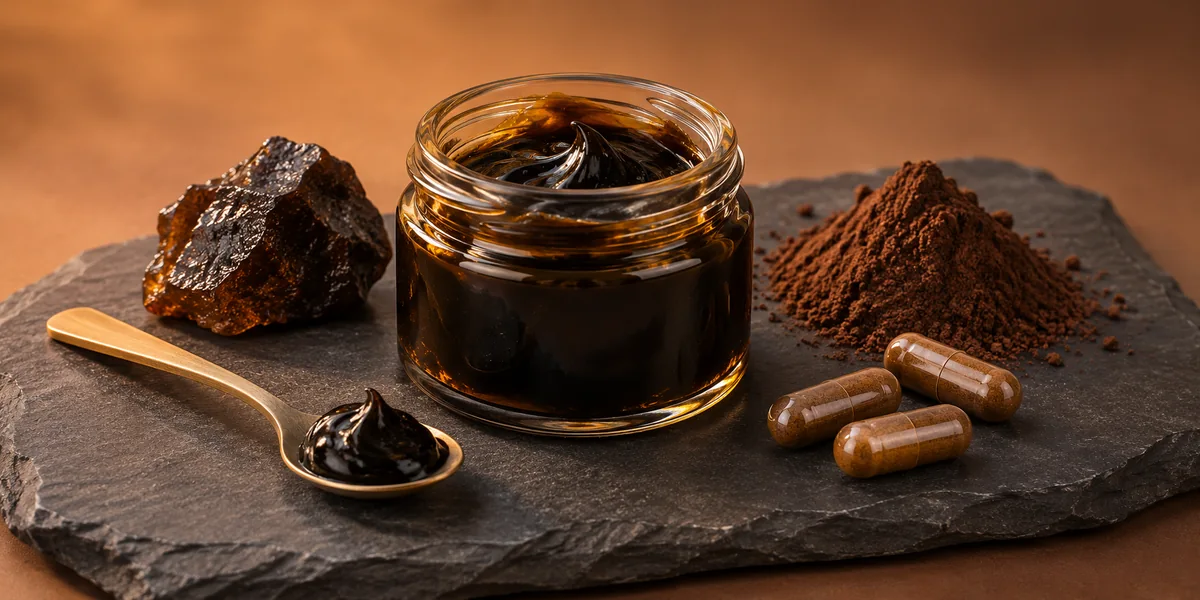
Forms of shilajit: resin, powder, capsules and gummies
Shilajit is sold in four main forms. Format does not decide quality, but it changes dosing and price.
Common forms of shilajit and what to watch
| Form | What it is | Upside | Watch out for |
|---|---|---|---|
| Resin | Sticky paste taken with a small spoon or at rice-grain size | Closest to the traditional material after purification | Measuring is approximate, strong taste |
| Powder | Dried extract | Easy to mix into water | May be blended with other ingredients, read the label |
| Capsules and tablets | Extract or powder in a fixed amount | Clear dose in mg | Fulvic acid content varies widely between products |
| Gummies | Shilajit with sugar or sweeteners and flavour | Pleasant taste | Usually little shilajit per gummy, high cost per serving |
Resin and concentrated extract are not interchangeable: compare the amount and fulvic acid percentage on the label, not the format.

Purity first: heavy metals and contaminants
Because shilajit comes out of rock, it carries what is in the rock. Published research is clear on this:
- A 2024 review in Biological Trace Element Research found about 65 metals reported in shilajit across earlier studies, including lead, arsenic, cadmium, mercury and aluminium. Most samples were within permitted limits, some were not, and the authors concluded that taking it without knowing the metal levels is not safe.
- A 2022 Saudi study by researchers at Imam Abdulrahman Bin Faisal University in Dammam and King Fahd University of Petroleum and Minerals analysed best-selling Indian and Pakistani shilajit and found lead, arsenic and mercury above permissible limits.
- A 2025 study in BMC Chemistry measured thallium, a toxic metal most standard panels do not include. It found up to 0.226 micrograms per gram in raw shilajit and up to 0.5 micrograms per gram in supplements, with some supplements higher than the raw material.
More broadly, a 2008 JAMA study found lead, mercury or arsenic in 20.7% of over 190 Ayurvedic products bought online, and three quarters of those claimed Good Manufacturing Practices (GMP). A GMP logo alone is not enough.
Key point: do not buy shilajit unless you can see the heavy metal results for the batch you will receive. A published certificate of analysis is criterion number one in our best shilajit ranking.
How to read a certificate of analysis (COA)
A certificate of analysis reports test results for one specific batch. Some brands publish it, some send it on request, many never provide one. Here is how to read it:
- Match the batch number Find the lot or batch number on the jar and check it matches the certificate. A COA for another batch tells you about the brand, not about the jar in your hand.
- Check the laboratory Ideally a named independent laboratory accredited to ISO/IEC 17025. An in-house summary is weaker.
- Read the four metals as numbers Lead (Pb), arsenic (As), cadmium (Cd) and mercury (Hg), each with a figure and a unit. "Passed" with no numbers is not enough. Thallium (Tl) on the panel is a rare bonus.
- Convert to your serving ppm means micrograms per gram. Example from a published certificate (Shamballa, lot 013): lead 0.32 mg/kg, which is 0.32 ppm. For a 300 mg serving, or 0.3 g, that is about 0.1 micrograms of lead (our calculation from the certificate), far under the EU limit of 3.0 mg/kg for food supplements.
- Look at the date and microbes A certificate over two years old may not reflect current production. A full COA also covers microbes (salmonella, E. coli, yeast and mould).
What does research say about shilajit benefits?
Search for shilajit benefits and you will find long lists of promises. The research behind them is much thinner. In short, human studies are few and small. A 2014 review by Sidney Stohs described well-controlled human studies as relatively few, with most research done in animals or in the lab.
Worth saying plainly: most recent human trials used one patented, standardised extract, and some were funded by the company that makes it: the 2019 strength study states it was funded by the manufacturer, and the 2019 skin study lists a grant from the same company. That is a reason for caution, and results for one extract do not automatically apply to every jar sold as pure shilajit.
Main human trials on shilajit (sources at the bottom of the page)
| Study | Participants and length | What was measured | Published result |
|---|---|---|---|
| Keller et al., 2019 | 63 active men, 8 weeks, 250 or 500 mg a day | Strength retained after a fatiguing exercise test | Stronger half of the 500 mg group kept more strength than placebo; no difference at 250 mg |
| Neltner et al., 2024 | 35 trained men, 8 weeks, 500 or 1,000 mg a day | Blood marker of type 1 collagen synthesis | Marker rose in both shilajit groups, not with placebo |
| Pingali and Nutalapati, 2022 | 60 postmenopausal women with low bone density, 48 weeks | Bone mineral density and inflammation markers | Slower loss of bone density than placebo, dose dependent |
| Das et al., 2019 | Healthy adult women, 14 weeks, 125 or 250 mg twice a day | Skin microperfusion and gene expression | Better perfusion at the higher dose; no side effects reported during the study |
These are results on specific markers in small groups, not yet repeated independently at scale. None of it makes shilajit a medicine for any condition, and none of these results can be transferred to a resin sold under another name.
The limits are worth spelling out. Each trial enrolled a few dozen people (35 to 63 where the table gives a number), the longest lasted 48 weeks, and they measured markers (strength in one test, a blood marker, bone density, skin perfusion) rather than long-term health. Each looked at a narrow group (active men, postmenopausal women or healthy women), and most used one standardised extract, not the resins sold in the Gulf. Animal and laboratory work, which makes up most of the research according to the 2014 review, cannot be transferred to people.
What a label may say. A food supplement is not a medicine. In Saudi Arabia and the UAE, as in Europe, it may not claim to treat, cure or prevent a disease, and health claims on labels are tightly regulated, so a jar that lists shilajit benefits as promises goes further than the evidence or the rules allow. Even pure shilajit with a clean certificate remains a food supplement: we describe it by its composition and purity, and that is how we judge it.
Dose: what labels and studies say
There is no official daily reference amount for shilajit, and labels themselves state "Daily Value not established". The only guides are the studies and each brand's directions:
- In studies: purified extract, mostly 250 to 500 mg a day, with one trial going to 1,000 mg.
- On the labels of the brands we compared on 18 November 2026: Shamballa resin, 150 to 300 mg a day. Mountaindrop Original Altai resin, 200 to 600 mg a day. Natural Shilajit resin, a rice-grain to pea-size amount (about 500 mg) dissolved in warm water. Primal resin, 500 mg a day. Nujimé Shila+ resin, 500 mg a day on an empty stomach.
The spread is wide because concentrations differ. Stick to your label, never combine two shilajit products, start at the low end, and add up any other mineral supplements you take.
Who should avoid shilajit or check with a doctor first
- Pregnant or breastfeeding women: there is not enough safety data. A case was reported in Greece of a pregnant woman who developed high blood pressure and low potassium after six months of mumie, which settled once she stopped.
- Children and teenagers: several labels limit use to adults aged 18 and over.
- Anyone on regular medication: ask your doctor or pharmacist first; interactions are poorly studied.
- Gout, high uric acid, kidney stones or kidney disease: there is not enough clinical data on shilajit in these groups, and it is mineral rich. Do not start without your doctor's view.
- Iron overload or haemochromatosis: shilajit naturally contains iron and other minerals, and some blends add more. Check the label and ask your doctor.
- History of severe allergy: a case from Italy described shilajit as a possible co-factor in exercise-induced anaphylaxis in a predisposed patient.
If unusual symptoms appear after starting (severe headache, palpitations, rash, digestive upset), stop and speak to a doctor or a pharmacist.
How to choose a good shilajit in the UAE and Saudi Arabia
- A published batch COA with the four metals as numbers. Before price, before format.
- A clear label: shilajit per serving in mg, fulvic acid percentage if given, and the other ingredients.
- Sensible claims: a serious product describes the material, it does not promise results.
- The brand's own store: many shilajit listings on large marketplaces come from third-party sellers with no certificate. Buying from the brand is the only way to match your jar with the published batch.
- Delivery to your country: several good brands deliver to the UAE but not to Saudi Arabia. Check before falling for a product.
- A realistic cost per serving: tested resin is not cheap. A very low price for a big jar is a reason to ask questions.
Shilajit brands we checked that ship to the Gulf
On 18 November 2026 we checked the certificates, prices and delivery of five partner brands. In short:
- Natural Shilajit: each batch tested by Eurofins in Madison, with an authenticity test (DBP markers) on top of heavy metals; ships to Saudi Arabia, the UAE, Kuwait, Bahrain and Oman. About SAR 184 or AED 180 for 20 g.
- Shamballa: the most detailed heavy metal figures we read, batch by batch, from Eurofins with a second laboratory; ships to the UAE and Qatar, not to Saudi Arabia. AED 112 for 10 g.
- Primal: two certificates per batch, one from an independent French laboratory; ships to the UAE only. AED 186 for a 30-day jar.
- Mountaindrop: fulvic acid measured at 74% by a named laboratory, free delivery to Saudi Arabia and the UAE. SAR 210 or AED 206 for 25 g.
- Nujimé Shila+: the lowest price per gram, batch testing announced but figures not published; ships to Saudi Arabia, the UAE, Qatar and Oman. SAR 95 or AED 93 for 30 g.
The full comparison, with marks, codes and price per day, is in our best shilajit ranking. Import duties and VAT (15% in Saudi Arabia, 5% in the UAE) can be added on delivery if the store does not include them.
Shilajit is not a substitute for essential vitamins and minerals
Shilajit contains minerals, but only small amounts per serving of a few hundred milligrams. For a real gap, a dedicated supplement does better: see our best magnesium ranking, or start from our best supplement guide for broad daily cover.
FAQ
Is shilajit safe?
It depends on the product first. Short human trials reported no serious side effects, but published analyses found lead, arsenic and mercury above limits in some samples, and a 2025 study found thallium in raw shilajit and in supplements. Choose a product with a published batch certificate of analysis, avoid it in pregnancy and breastfeeding, and check with your doctor if you take medication.
What are the proven benefits of shilajit?
None is proven to a strong standard yet. Some small studies suggest effects on specific markers, such as strength retained after exercise, a collagen synthesis marker, and bone density in postmenopausal women. Most used a single commercial extract, some were funded by its maker, and none has been widely repeated by independent teams.
How can I tell if shilajit is genuine?
Popular home tests, such as dissolving it in warm water or softening it in your hand, only tell you about texture and say nothing about heavy metals. The serious check is a certificate of analysis from an independent lab, with a batch number matching your jar, listing lead, arsenic, cadmium and mercury as numbers and fulvic acid by a named method.
How much shilajit should I take?
There is no official reference dose. Studies mostly used 250 to 500 mg a day of purified extract. Resin labels usually suggest a rice-grain to pea-sized amount, roughly 100 to 500 mg, once or twice a day. Follow your product's label, start low and never combine two shilajit products.
Can I take shilajit with medication?
Interactions between shilajit and medicines are poorly studied. If you take medication for blood pressure, diabetes, thyroid or any long-term condition, or you have kidney disease or gout, ask your doctor or pharmacist before starting. Tell them about every supplement you take, as some shilajit products also contain iron or other minerals.
Sources
- Kamgar et al., review of shilajit chemical composition, Crit Rev Anal Chem 2025
- Hussain and Saeed, heavy metals in shilajit, Biol Trace Elem Res 2024
- Aldakheel et al. (Dammam, Dhahran), metals in Indian and Pakistani shilajit, Biol Trace Elem Res 2022
- Kamgar et al., thallium in shilajit and its supplements, BMC Chem 2025
- Saper et al., lead, mercury and arsenic in Ayurvedic medicines sold online, JAMA 2008
- Stohs, safety and efficacy of shilajit, Phytother Res 2014
- Keller et al., shilajit and fatigue-induced strength decline, J Int Soc Sports Nutr 2019
- Neltner et al., shilajit and a type 1 collagen marker, J Diet Suppl 2024
- Pingali and Nutalapati, shilajit and bone density after menopause, Phytomedicine 2022
- Das et al., shilajit and skin, J Am Coll Nutr 2019
- Trial record NCT02762032, ClinicalTrials.gov
- Stavropoulos et al., case in pregnancy after mumie use, Gynecol Endocrinol 2018
- Losa et al., anaphylaxis case with shilajit as co-factor, World J Clin Cases 2019
Food supplements are not a substitute for a varied, balanced diet and a healthy lifestyle, and they do not treat or prevent disease.

Best Supplement Arabia content is written by our editorial team from the information published by the brands. Scores out of 10 rely on a public grid of 5 criteria*, completed by the editorial team’s judgement.
To support Best Supplement Arabia, links on the site are affiliate links: we may earn a commission when you buy through them, at no extra cost to you. Using the site means you accept our terms of use and our editorial policy.